Showing posts with label writing prompt. Show all posts

Friday, 17 February 2012

Of Nuance and Narrative

Prompt of the Day #12
Pick a fairytale that you connect with and retell it as if you are a narrator at a dinner or function. Imagine the setting you are in, think about the story and what it may mean or symbolise, now consider the audience you are recreating the scene for. Reinvent the story in your own words. 


Depending on what critic you're reading, the house of fiction has a million windows or a punitive number of doors. This is the metaphor applied to narrative perspective - we can read a piece of fiction in a variety of ways, we can approach it from many angles, but when you're writing it you can only write from a perspective. This is the narrative voice. Whether that voice is your own, a fictional first person, the third person limited, third person unlimited etc. You could probably write in the first person plural, though perhaps it would feel like a royal 'we', and I can think of a few children's books and 'adventure quest books' that are written in the second person but there's a leading voice in that case, which makes me hesitate to cast judgement on how well it's ever used. 

My point is that the way you present your story, your narrative style, is the foundation of everything you write. Most of the critics I'm thinking of apply this view to stories and novels, although I'd hasten to add that it is just as vital in poetry. If you wield your narration well you can write just about anything without recourse. 

"But what on earth does that mean?" You may very well be asking. I will try to reply.

Narrative is a story. It's the form of narration, which is how you tell the story. And no matter how hard you try, it will always have a 'narrator' lurking in some corner of the subconscious text. Even if the touch of the 'author' is as fleeting as a love on the dancefloor, that voice is still coming through. Narrative is how you stitch it all together, how you weave your words into a pattern which turns into a tapestry of tales. You can do this like Balzac who saw himself as a 'historian' depicting the actualities of contemporary French society and frequently breaking into unexpected, decidedly 18th Century style commentary; you can do this like the Father of Modern Narrative: Flaubert who was concerned about 'writing a book about nothing' and whose presence in his works is hardly detectable. You could write like Nabokov with complex unreliable narrators such as those from 'Despair' and 'Lolita', or like George Eliot with her reliable, third-person omniscient narration. Or you could be writing the next modern epic, puzzling many of these aspects together as Joyce does to some extent in Ulysses. 

Which ever you decide, narrative style is a crucial aspect that you need to develop. You don't have to maintain a single style though all of your work, nor even continue it through a single poem, story or novel. 

Lemony Snicket - Will You Ever See His Face?
Lemony Snicket uses a Dickensian style of narrative through his authorial persona, he has developed a narrative voice and has crafted his own space within his fictional world to great amusement and success. His style also allows for a sense of authorial reliability, albeit with a tinge of reluctance, whilst also conveying the author as far from omniscience. Journalistic, investigative language creates this effect. But if you read the Odyssey there's a sense that we cannot always be certain what is truth and what is rumour when it's not Odysseus' voice narrating his tale. Throughout the epic, examples of how other 'bards' have told the tales of Greek heroes returning home, including the eponymous hero, have distorted reality - thus we see examples of both reliable and unreliable narration.

It doesn't really matter whether you want to be 'part' of your narrative or not - nor does it matter if you want to fashion yourself after a favoured writer or if you want to create a style that's uniquely yours. What's important is to develop the write style for your poem or prose. Using the first person might mean that you limit the amount of action your character can follow and therefore require a lot of explanation. Using the third person omniscient might seem too antiquated for a tale set in the modern world. If your work is meant to be 'light reading' or 'pleasure reading' maybe you don't want to create an unreliable narrator, or you might benefit from exactly that if you want an active readership, as you might if you were engaging them in a mystery or something similar. 

The nuances of language and storytelling are captured when a reader engages with the narrative. It's the little things that become striking when it's well done. So turn your work into something literary and exciting. Develop your own narrative style. 

Thursday, 16 February 2012

Of Music and Melancholy

Prompt of the Day #12
Come up with a playlist that fits the plot of your story or poem. This could be based on the emotional aspects of the content, the diction that you use, descriptions, voice or characterisation. Or pick three songs and write a piece based on your response to them. Try and do this without it becoming a 'song-fic'.

This was meant to be posted on Valentines Day but when your computer gives up on the internet there's not a lot you can do to stop it. Instead, I spent a lot of time planning essays, thinking up interesting prompts for you all, drinking cup after cup of tea and catching up on my Joyce criticism. Sounds like an ideal Valentines. However, this prompt was lurking around in my head even before the technological gremlins vacationed. At first I was focused on the Melancholia but having watched Drive before heading home on Tuesday evening, I became incredible aware of how much effect music has on our interpretation of a scene. 

Of course this is no huge revelation to anyone. Would Jaws be scary with it's sinister two note theme circling our psyche? Or would Casablanca strike our hearts so deeply without the nostalgic notes struck when Elsa bids in her low, whispering voice "Play it, Sam." Indeed, I think it is safe to say that music in many ways communicates to us on a level that mere words cannot. Drive reminded me of the way music can move so much of the drama of play or a film, perhaps because so much of it relies on the cinematic framing of Ryan Gosling's face accompanied by eery, tension-building 80s tunes. Much of the 'peculiar stillness' of the movie,  is caused not by the lack of true script - much of the film goes without conversation, nor by the 'laconic', nameless protagonist; the music tells us where the film is headed, where our mind should move as our ears are reacquainted with eighties synth-pop. 

In 'Musicophilia', Oliver Sacks states that 'Music is part of being human'. He also alerts us to the fact that Darwin speculated:
"Music tones and rhythms were used by our half-human ancestors, during the season of courtship, when animals of all kinds are excited not only by love, but by strong passions of jealousy, rivalry, and triumph” and that speech arose, secondarily, from this primal music.
This could be true, or it could be mere 'speculation' as Sacks suggests. What is key is that music, for many, is a thread that binds them to emotion, ties them to humanity, reminds them of life or reflects the Beautiful. It inspires, moves, remedies, offers support or conjures a spectre of some dimly remembered history. It is no wonder then, that so much of art is inspired by music. 


Classical writers, for whom a poet was a 'bard',  saw their work integrally tied to music. This is partially to do with mythological gods such as Pan with his flute, particularly in madrigals and Georgic poems. Orpheus cannot be neglected, for who else appears so regularly in Miltonic verse, emphasising the mortal song and emphasising the problems of the incomplete. Phoebus (or Apollo) whose 'Aonian harp/lyre' was the sweetest, after whom English literature references the 'Doric lays' and who was also the 'prophetic god' is the symbol of ideas such as Vates, the poet-prophets and the figure that Socrates claims his destiny from. 


What is clear, though I wish I had more time to go into details: from Shakespeare whose famous line demands that 'if music be the food of love, play on!' or Stevie Wonder saying that 'music's a language we all understand', it is clear that music is one of those mutual loves of numerous great writers. It also cannot help but be connected to the art of writing because if you look at the geneology of literature it can always be traced in some way to the musical, the rhythmic.


In 'Il Penseroso' and 'L'Allegro', Milton accepts the connection between music and poetry - the titles of these paired poems are in themselves musical expressions - accentuating the idea that music both unifies a community (L'Allegro) but can equally 'dissolve' and individual 'into ecstasies' (Il Penseroso). These poems, whilst debating the benefit of Mirth or Melancholy, use music as a symbol of the relationship between external and internal worlds. 


When you're thinking about the future and your tenebrous, uncertain position as a writer, you may feel overwhelmed by the challenges ahead of you. In those times, it's time to figure out what inspires you, consider how you can connect with your characters or deepen a poem. Sometimes you have to turn over the struggle you're feeling and examine it, create what you can from what you're feeling - this is what Milton's doing, he's contemplating his future and examining the path he hopes to follow. Furthermore, he's relating to his dilemma through his relationship to music, using something that effects both sides  mutually, albeit differently, thus steeping his writing in something that appeals on a universal level as well as a personal one. 

Monday, 13 February 2012

Of Learning and Love


Prompt of the Day #11
What does the future hold? Is it a scary place? Is it a Utopian, Golden Age? Where do you or your character want to end up? Do you miss the way things were? What do the older generations think about it? 
Write a poem or story about the future - whether its an idealistic or apocalyptic world. 


After a long couple of emails back and forth between myself and a writer in a funk, it was decided that this week will be dedicated to two things: 'Love', as it is Valentines Day tomorrow, and different ways of 'Learning' how to improve your own writing. These two themes will involve: 
  • looking at some of the love poetry of Ovid, Catullus and some more modern writers; 
  • thinking about relationships between characters and voices; 
  • considering your relationship with your own work
  • learning ways that you can make yourself a better writer. 
That's why I started today with a prompt about the future - you know what you want, you know your pen, it's up to you to achieve what you want, no one else. So I want to keep this very short today and let you think about these things. 

If you want to be taken seriously the only person who can force the world to take notice is you. 

Now I'm going to point you here: 25 Things Writers Should Stop Doing. 

Think about it.

Je serai poète et toi poésie,
SCRIBBLER 

Thursday, 9 February 2012

Of Ideas and Implants


When you think about it, how many of your ideas are your own? Create a story or poem about discovering that everything you know is a dream, an idea plotted into the fibrous neurons of your brain. Or imagine a character who realises that they've been injected into another person's life.
Consider the implications this may have on your sense of personal identity and how this could effect societal structure such as the Justice System or creative industries etc.

Wednesday, 8 February 2012

Of Gradgrinds and Great Expectations

Prompt of the Day #
It is the late 1800s and the world around you is a strange, cold place. Manners dictate your interactions with men and women. The lull of the country and the lure of the city compete for your affection. Industry is overwhelming traditional ways of life. The middle classes are entrenched into society but a 'self-made man' is still an object of scorn. Utilitarianism and Religion compete over societal morals. Everyone and everything is moulded to fit the figure of a newly mechanised world. 
Write about a day in the life of the19th Century. 


Happy 200th Birthday Mr Dickens

Many of you will have noticed the Google image of the day: all in honour of one of the greatest writers than Britain has ever seen. 

Prolific, passionate, political - Dickens' novels remain some of the most influential works of fiction in the English canon. From Hard Times' clinical consideration of the effects of extreme Utilitarianism and the import of imagination, to the the heart-wrenching stories we find within a Christmas CarolNicholas Nickelby or Oliver Twist, Dickens was a master of character and plot. His ability to write serials, a term referring to the presentation of chapters published one at a time either days or weeks apart in magazines and newspapers, was crucial to his success. Even if he was boring you to tears at the beginning of a 'chapter', he could have you coming back for more by the end of it. Part of this is through suspense, other times it's through the introduction of sideplots and mysteries that you feel the urge to unravel. 

Many critics, including James Wood of 'How Fiction Works' laud his ability to create characters. In Hard Times, the plot is driven by our understanding of the 'metallurgical Louisa' and her relationship with her 'mathematical' brother, her 'eminently practical father' and the 'brazen' Mr Bounderby. Epithet-type motifs such as these recur through the novel (in fact 'eminently practical' appears no less than 7times - mostly in one chapter!) and act as signs for the characters. Similarly, the voice of the narrator will often bleed into the voice of characters - for example with the heavy repetition of the word 'facts', this is firstly the voice of McChoakumchild but later is adopted by the narrative voice to describe the city - this creates a sense of how man shapes a society, how philosophy can change language, thought and appearance.

For me, I see the conflict of the novel as a dialectic between the social and the personal - where the social dictates that Louisa marry Bounderby or that Coke Town work its weary way into the ground; but also where the personal suggests Louisa wants to 'burst out' of the fire, that Coke Town still glows with 'faery palaces'. Dickens' art is thus in the way that he sets up characters as caricatures, embodiments of the problems at large, whilst maintaining the reader's sympathy. 

Character is certainly an art and its well-worth figuring out if you have that Dickensian grasp on characterisation. Not everyone does, Iris Murdoch still claims that though the mark of a great novelist is to be able to create a plethora of characters that are unlike oneself, she has not achieved this. James Wood even cites her as saying: 
"How soon one discovers that, however much one is in the ordinary sense 'interested in other people', this interest has left one far short of possessing the knowledge required to create a character who is not oneself. It is impossible, it seems to me, not to see one's failure here as a sort of spiritual failure."
Whilst you could be as melodramatic as Murdoch, you could also realise that Dickens had a talent - he was a daily rag writer, surrounded by the great age of satire and the caricature was a natural tool in his belt of brilliance. You don't have to be disheartened. You can think about which of these sorts of writers you are. Try you hand at creating character upon character, think about their voices and their mannerisms. Is there a particular word or phrase that summarises their situation or personality? Have they 'freedom' from the inky dictatorial pen? Try thinking about how you introduce them - Dickens has an amazing way of describing everything about a person, except their appearance. And why not play with their situation - what world are they born in? Are they white or blue collar? What's the political situation of the time? 

Let Dickens' influence continue and wish him a very happy second century.  

Monday, 6 February 2012

Of Freedom and Freeverse


Prompt of the Day #5
What is freedom? People fight for it, people die for it, people march down streets proclaiming their right to it; in fact, we all seem to believe that we're free and feel terrified when our autonomy is threatened. 
Write about Freedom. 
Be it to do with the abstract, a character, society or something else entirely. This week is all about Freedom. 


Freedom today is a massive issue, particularly when it comes to things like Freedom of Expression, Intellectual Freedom, Free Speech and such. When you think about it, it seems like its constantly under threat, think about things such as CCTV which are already an everyday aspect of our lives, or the Congressional attempt to introduce SOPA. Think about how debates rage over whether or not we have the right to know about the lives of football players or whether they have the right to privacy. It's about the freedom of the press - shouldn't they be able to publish whatever they see fit? Surely a super injunction impinges on the freedom of speech and expression? But then what about the right of the subject in question - are they not allowed to live their life the way they wish to without worrying about it being splashed across international news stands?


Novels such as Orwell's 'Nineteen-Eighty-Four' build off the fear of what would happen in a world without freedom of anything, where autonomy is a vague dream. Both the film and the original graphic novel, 'V for Vendetta', continue along a similar idea, where totalitarianism grows out of human greed and fear and overwhelms society. Banksy, the elusive British street-artist, frequently alludes to a belief in the power and necessity of freedom. 


When poets such as Owen, Sassoon, Pound, Lowell, Yeats and Eliot were writing, free verse was an expression of freedom too. Many of their writings reflect the deterioration of society, a breakdown in structure and hierarchy. Lowell's poems 'Memories of 5th Street and Lepke' as well as 'For the Union Dead', look at how, on the one hand the writer and others like him were prosecuted despite acting within the realms of freedom of expression, compared to the blind 'savage servility' of the modern man going about his day. His writing evokes images of acceptance - as if fatalism is our own creation. Similarly Eliot addresses this idea in his own writing with what we would likely describe as a strange sense of existentialist anxiety. To these poets, form could either instruct or undermine an idea. All of them were well-acquainted with sonnets and villanelles, iambs, trochees and anapests - they experimented with meter and verse to emphasise the conflict between freedom and society, the interplay of rules. 


If you're a writer, you not only have to be somewhat aware of deep-seated, human emotions towards themes such as these (even if it's only on a vague level), but you also have to think about your form and what that will do to your writing. This latter point may seem more valid to the poet but the short story writer can play with just as many conventions - think of Joyce and the voice of the nationalistic Dedalus, or the way Dickens' characters sometimes take on the voice of the narrator and vice-versa. 


So think about what you're writing about and whether there's anything deeper to the ideas that you're exploring. Think about the modern day mindset and how your themes can appeal to them. And while your at it, why not explore ways of emphasising things in a way that's subtle and interesting as well as unique. 

Please note that this is the first Monday of our blog and therefore we are introducing the weekly theme for all of our prompts until Sunday


Sunday, 5 February 2012

Of Explorers and Elements


Prompt of the Day #4 
Imagine that you or a character has just come home from the longest journey they've ever made. Think about their immediate reactions to being home - relief, joy, worry, distaste -  think about how they might narrate their story to friends and how it might change over time. How do they feel after the initial return - content, restless, excluded, changed?


When Homer wrote the Odyssey, the protagonist, Odysseus has set sail from Troy after the happening of the Illiad, and is trying to return to his native Ithaca after ten years of war with the Trojans. His voyage, which should have taken a couple of weeks, takes him ten years. In those ten years he battles monsters, listens to Sirens, meets and 'befriends' two beautiful Goddesses: Circe and Calypso, blinds a Cyclops, travels to-and-from the Underworld, loses all of his comrades, wanders from civilisation to civilisation and eventually returns to discover his wife is being pressured by a bunch of irksome suitors trying to usurp him from his rightful throne. As an epic poem it has been one of the most influential pieces of literature in Western canon, inspiring hundreds of writers from the other much lauded Classic: Virgil, to Shakespeare and James Joyce. In fact, poets such as Tasso and Spenser, who both wrote Christianised epics, followed very closely to the themes and even the language of Homer, recreating almost the entire Odyssey albeit with characters plucked from morality plays. Similarly, if I was going to bore you into a blob of vapid expression, I would list the huge number of poets that have taken twenty lines of the Odyssey (or the Aeneid) and turned them into page long poems. 

The influence of the Classical Epic is phenomenal and it is characterised by voyage. Not just any voyage mind you, but long, never-ending, traumatising, life-destroying, character-building voyages. Christopher Booker even acknowledges this as an archetypal example of one of The Seven Basic Plots: Voyage and Return. Many fantasy novels are based on this idea - take the Lord of the Rings, or the Belgariad as examples. In these, 'The Quest' may start as the general premise, they may have to 'Overcome the Monster', there may even be hints of Comedy, Tragedy, Romance etc but ultimately the 'Voyage and Return' is the overwhelming plot for the story. Why? Because a voyage, like an epic, can encompass hundreds of different ideas and emotions and can reflect both literal and metaphorical transformation. With Odysseus, he desperately wants to go home, but he has to overcome dozens of trials in his wanderings. With the Red Cross Knight or the Knight of Termperance (The Faerie Queen, as inspired by Homer), these figures have to encounter the thing that most tempts them, their apposite character, in order to really become the embodiment of a virtue. Voyage, in allowing a character to travel from place to place, also allows them to develop through obvious challenges, to triumph and fail and gives the writer free reign to examine a plethora of human emotion.

The Return is equally important. Of course, the joy of arrival for Odysseus is somewhat dampened by the fact that he has to disguise himself in order to judge the loyalty of everyone he has ever known - the slave woman that nursed him as a babe, his wife, his father etc. Furthermore, he has returned to discovered he is MPD and his wife is being heckled by a number of lascivious old aristocrats. He promptly smites them, intending to remind you of how he is both Odysseus the Wanderer but also a hero of Troy but he still has to go through the trial of Revelation and after all this, he finally, truly 'Returns'. Inspiration, can come from the different monsters he fights (ie. The Lotus Eaters), the different people he meets (ie. Circe), the great and ridiculous 'weeping', the moments of intense ekphrasis... the list goes on. 

Tennyson's poem 'Ulysses' is one example of how a writer uses a classical text to inspire his own writing. Tennyson, despite not having such a helpful manual as Booker's explanation of plot, considers the character of Odysseus/Ulysses and using the voice of the hero himself, imagines what the man thought of his life twenty years on from The Return. So if this is the traditional timeline for Odysseus:
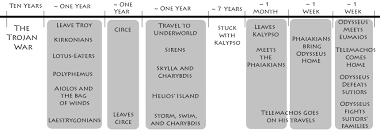


Then add another twenty years on with Odysseus back as king of 'barren' Ithaca and you can imagine how he might be feeling. He had ten years of war, ten years of voyaging and then the following years of peace. Tennyson, who also rewrote the scene with the Lotus-Eaters, created a scene where Ulysses seems to want to return to the life he lived as a traveller, as famous hero surrounded by myth instead of fact. Yet the narrator also seems reminiscent of the Sirens, who promised him both fame and 'knowledge ... beyond human understanding', often described as mantric truths. This is Tennyson's 'gray spirit yearning in desire/ To follow knowledge like a sinking star,/Beyond the utmost bound of human knowledge.' His creation is one that is no longer content with the 'still hearth' and 'barren crags' or the 'aged wife' he fought for in the original epic. This is a character who seems to have carried the temptations of the Siren song home with him, has become obsessed with it, who has romanticised the 'dark broad seas' so that even Charybdis's gaping mouth and Circe's idyllic island become an equally enticing adventures. 

It's almost as if Ulysses is going through a mid-life crisis. As the fear of being 'made weak by time and fate' juxtaposed to the idealised 'old days', remains emphasised throughout the poem, we initially imagine that this character is sincerely desirous of the travelling life because he is ageing, realising his increasing impotence as his son takes over the rule of Ithaca. Yet, due to the hints towards the sirens that he alone heard, we are also encouraged to doubt, to read with a pinch of scepticism, a slither of active readership. Why  are the 'gulfs' that  'wash ... down' and the 'Fortunate Isles' are juxtaposed against each other as similarly lauded adventures? Is the poem really about literal travel? Does he really want to return to a 'newer world' or are the references to age, the 'end', seeing 'the great Achilles' actually suggesting that Ulysses is ready to embark on the last adventure, into death itself? Or does the final sentiment that determines 'not to yield' imagining that he is desperate to cling to life, to return to life? Does the siren song promise him an escape through life or through death? And is Tennyson being serious with all of this? These are all questions that we can play with. 

Tennyson, doesn't just use very deliberate allusions linguistically but he also uses meter to emphasise the conflicting rationales behind the narrators opinions. This is particularly evident with the use of spondees in the lines, slowing them down as if the narrator is luxuriating in them, emphasising the sense of idealism, whereas the following line uses a trochiac opening to accentuate the feverish fervour of his excitement. Against a predominantly iambic poem, lines like these are striking, lending a sense of strangeness that suggests that maybe the character is not entirely in his right mind. 


You can read a poem like this in dozens of different ways. I tend to read it ironically. But what we all have to see is how Tennyson uses a familiar trope and a well-known story and develops it into his own, expressing something that is ultimately very personal and unique to his time. A new perspective on a hero can usurp  convention. In this case it's the opinion that once the story is concluded, the voyage complete, the return celebrated, things will right themselves. In the case of the Odyssey, we're even guaranteed an end to his tribulations through the use of deus ex machina. Yet Tennyson's poem reopens the page for us.


When you're creating a character, think about how you're developing him/her. Consider what journey your character is going to go on, whether it be literal or internal and think about what sort of person they are, not only in the past but in the future. 


Je serai poète et toi poésie,
SCRIBBLER

Saturday, 4 February 2012

Of DOs and DON'Ts

 Prompt of the Day #3
Think about the worst mistake you've ever made, or the worst mistake you think someone you know has ever made. What was it? Was it highly embarrassing or did it hurt somebody? What happened afterwards? How did you feel when you did it? How did it feel afterwards? A thousand emotions can stem from looking back at a moment but it's harder to remember the exact emotions of the actual experience. 
Try writing two versions of the same scene, one in the present and one in the past. Contrast what the immediate experience is like compared to the feelings that run through one's head in hindsight.


Oscar Wilde said: If at first you don't succeed, redefine success. When you think about it, this is all literature is about. Shakespeare redefined the sonnet, Laurence Stern redesigned Sentimentalism, Descartes revamped philosophy, Pope reconstructed English Nationalism. In fact, not to reinvent the wheel, but if we go back to considering Shakespeare - he rewrote dozens of stories, turned them into miraculous plays that most of us literature students still have to study today. I've even heard him called 'the Father of Fanfiction', which I suppose if you consider plays such as King Lear or Romeo and Juliet then you might just see what they mean. 

If you look at history you can see the effects of literature on the psyche of societies. In the 18th Century, Bardic writers were trying to convey the sense of a new, powerful, affluent England and in order to do so, like Pope, they used Classical mythology to imagine that once upon a time this is what our country was like. You see it in America too - the creation of a sense of identity through literature, for example in the Jack Tales. The idea of Sage writing, including the criticisms of Ruskin and Arnold, or perhaps simply the didactic works of Dickens, were similarly about evoking a sense of literary identity and society. When you come to writers such as TSEliot and James Joyce, what were they doing if not showing how literature and how we think about literature needs to adapt and challenge and engage with the modern man?  

How about Realism? Realism with a capital R, is supposedly a movement that started in France circa 1800 appealing to lofty ideals such as verisimilitude and poetic mimesis. Yet these are ideas that Aristotle and Plato debated whilst they reclined and had grapes fed to them by small boys. When you actually try to read some of the novels produced through this 'movement', you have the extremities of Balzac, Flaubert, George Eliot and Dostoevsky. The fact that there are so many differences between them - Balzac claims to be a 'historian', Flaubert to have written about 'nothing' etc - only emphasises how even with those who desire to appeal to the same ideal, in actuality are simply redefining what came before. 

If we break it down even further, we can inspect Christopher Booker claim that there's only Seven Basic Plots. So whether you're a writer of crime fiction or romance, fantasy or drama, poetry or prose, all you're doing is redefining what is already written. But that doesn't mean that your story is any less important, there will be different characters, different styles of writing. 

When you write, think about the story and its predecessors, think about where you're coming from and what you're recreating. Think about the way you think you can improve upon what's come before, or how you think you can offer something unique. Don't be afraid to draw upon the works of your literary ancestors, as long as it's not full-on plagiarism then, if they're not dead, they should be flattered (for example, if you have a favourite poem, write a response as I did in 'Dear Mr Eliot'). 

To end, Albert Eistein said:  He who joyfully marches to music in rank and file has already earned my contempt. He has been given a large brain by mistake, since for him the spinal cord would suffice. 

Don't be a satisfied pig, fellow Scribblers, and don't march in line like sheep. Even if your writing adheres to convention, play with them. Sometimes all it takes is a little, deliberate mistake to turn your writing into the extraordinary.  

Je serai poète et toi poésie,
SCRIBBLER

Friday, 3 February 2012

Of Creatures and Coffee


Prompt of the Day #2
Awww isn't this little guy the cutest thing ever? He scampered up the Christmas tree and then peered out at us for this adorable photo. Not all animals are this cute, sometimes they're scary, sometime fantastical, sometimes they don't even exist but creep along the edges of your consciousness.
Write about a creature. Think about their personalities, the way they move, whether they're friendly or cranky. 


When I woke up this morning, a phrase here that actually refers to my friend calling me at 1pm to enquire about my whereabouts, I was bewildered and in much need of a cup of tea. I found my eyes focusing on the Monkey Picked Tea that I was given for Christmas and for a moment I pined for a good brew. Instead, I found myself vellicated from my bed, into the shower and out of the door. There was far too much blood in my caffeine system. 

Think about what things help you to focus. Perhaps it can be as inspiring as any prompt I can offer. Tea certainly sparked something for Anon of Edinburgh. 


Be it in coffee or my typically British tea, I need my fix in order to focus. I can be anywhere in the world, in a pub, my bed, a desk, perched in a tree, upside-down on the monkey bars, hidden under a chair, lurking in a cupboard, surveying from an alleyway, submerged in a swamp - anywhere - and a little bit of caffeine will ensure my continued application. It's useful to know what keeps you on track. So as soon as I entered Jack Sprat I was at the till and ordering a giant bowl of coffee. It is America after all. 


Je serai poète et toi poésie,
SCRIBBLER

Thursday, 2 February 2012

Of Barbours and Books


Prompt of the Day #1
Don't they look warm, playing in the leaves that are left over from autumn, the glow of spring dappling down on them in their snug coats.
Write about a coat - either about the places it goes, the people it hugs, whether its old or new, what makes it a good or bad one. 


Good Morrow Fellow Scribble Bugs,

Today I decided to focus on the Barbour. Coats are wonderful things - they can keep you warm, protect you from the wind, have extra pockets, conceal the terrible shirt granny gave you for Christmas, act as a wily disguise, attract large crowds of admirers, give you a different body shape, become a blanket or a pillow, the list goes on. Now THE BARBOUR is a type of coat, it's a jacket, it's a fashion statement, it aligns you with generations of Brits that attend point-du-points across the country and it also seamlessly blends you into the country background around you. For me, the Barbour is also a name with many memories attached. I used to dress up in my mothers and hide under my fathers, my best friend worked in the New York store for two summers and I have a wonderful Zara equivalent. I also had a teacher at UNC-Chapel Hill who was called Reid Barbour and for those of you acquainted with the writer Sarah Dessen may be familiar with the name. 

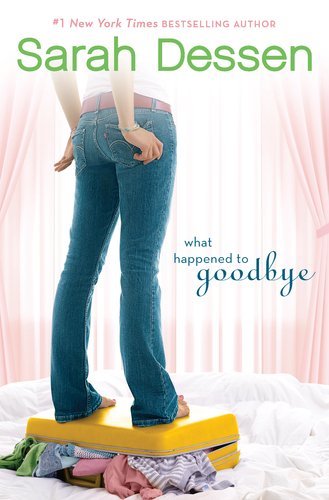
In her novel 'What Happened to Goodbye' there's a line which reads:

 “…so ravaged it looked like one of my term papers from when I’d taken Ap English with Mr. Reid Barbour, the hardest teacher in my last school.”

Yes, this in fact a reference to the same man who scrawled across my university papers on Milton's Paradise Lost, a man considered by many as a charismatic demon - a phrase here that means 'a man that is both at once incredibly impressive and equally hard to impress'. He's the teacher everyone wants to have: enigmatic, shoe-less, passionate. 

And here he is: an INSPIRATION.

Now it's your turn. Pick up your coat and think about those inspirational aspects of your life. Maybe they can turn you into a #1 Best Seller for the New York Times

Je serai poète et toi poésie,
SCRIBBLER