Saturday, 18 February 2012

Of Opportunity and Online Influence


Prompt of the Day #13
Pick your favourite short story or poem, reread it, make any last minute changes. And submit it. Send it to a literary magazine or an online newsletter; give it to a favoured teacher or a extremely critical friend; thrust it out into the world and accept whatever praise or criticism you receive. 
Do it.
 Now. 

Nothing is ever going to happen if you don't make the move to make it happen. 

Scribblers, the modern world is at our finger tips. You're taking part in it right now by reading this blog.  

Do you really want to live like this?
Carpe Diem! said Horace, Seize the Day! You should be doing the same. Everyday that you write you're engaging in an art that will only come to fruition if you make the move to make it happen. You can't sit and hope that dreams come true, writing isn't about that. Writing is about publicity, in many ways the audience is more important than you are. Which means you have to go out and find one. Even before you publish, you need to think about who you're trying to engage with - even if it's people just like you. 

The online community is huge, there are hundreds of writing websites out there: Writing.com, Figment.com, Helium.com etc etc. 

You have no excuse not to show at least extracts of your work to someone. You can put them up briefly and take them down once you have a second opinion. You can accumulate a portfolio and create a cult of personality for your authorial persona. These are easy, abusable opportunities you can't afford to waste. Everyone else can use them, do you want to be left behind?

When you apply for internships (which I'm doing right now) or seek any kind of employment, you don't apply to just one or two names or businesses. You send off dozens of letters, print page upon page of CVs, spend hours composing emails that you know will likely not be replied to. And when you don't here back you keep calm and carry on with a little bit of your heart aching but knowing that you have no choice but to keep applying and keep trying. 

If you meet someone who might be able to help you, whether it's at an event, a conference, your local book store, on the train or because you accidentally picked up the wrong bag at the airport, use them. Make contacts, find out their details and email them or call them as soon as is polite. Don't ever pass up an opportunity that comes your way because you don't know how often they'll come up , or at least not without thinking about it. It's good practise to find out more about any chances you're given.

Think about some of the 'famous' today - you have singers such as Birdy, whose angellic voice arches away from her gawky, fifteen year old self and is beloved by many because she was discovered on youtube. Similarly, Bo Burnham, a 20-something American comedian was discovered on youtube and consequently sang at the Youtube Awards and was awarded a prize at the Edinburgh Fringe Festival. Charlie McDonald, Phil DeFranco, Jenna Marbles - they're all youtube sensations. Blogger Neil Pasricha has just published 'The Book of Awesome, after his wordpress blog became somewhat of a positive thinking cult. How do you think the Huffington Post started by the way? Or Perez Hilton? Or The Daily Beast? If those don't count as success stories I don't know what does. 

So seriously Scribblers, take every opportunity you can and use it well. You never know when you might finally break through into the real world. Then again, my favourite version of my favourite song by Otis Redding sit below and the singer, whose powerful voice collects silver coins on the streets, claims that he's in 'the joy industry'. Hopefully those things don't have to be exclusive principles for us. 


Je serai poète et toi poésie,
 SCRIBBLER

The Hand that Holds the Pen


When we first started this project we knew that we wanted to dedicate at least some small corner to the Novel, so we asked aspiring scribbler Chesnaye Long (aka Quaddy) if she'd mind taking part in our blog as a contributing think-tank. Little did she know that we secretly harboured a fervent desire to victimise her latest novel: Eve of the Gods. The twenty-four year old Floridian, who claims the mental age of nine and the humour of the snarkiest version of Elizabeth Bennett you can think of, was interviewed earlier this week. This is what she had to say for herself:


The Scribbler: Off-camera (or before the pen hit paper) you talked about yourself as having been at [novels] for years. How long is that exactly?

Quaddy: A really long time - I've had an online portfolio for ten years now.

TS: That would put you in your early teens! Why do you write? What inspires you?

Q: Well history, mythology... I'm a massive fan of the BBC series, Dr Who. That's played a key part. But I write because I love stories. I love telling them and reading them. If I didn't have such horrid stage fright, I'd act them out more too. 

TS: History and Dr Who, that's an interesting mix. What about authors and books?

Q: Oh goodness...Neil Gaiman is up there. Christopher Moore’s Lamb, however, is possibly the one book I’ve enjoyed most in the whole world. Jane Austen always delights. But to name them is not to discredit the hundreds of other novelists whose works inspire me daily. If I had to pick books. Hmm... Chris Moore’s Lamb, Jane Austen’s Pride and Prejudice, Gaiman’s American Gods... have influenced even my religious beliefs, or perhaps mirrors them. Either way, it speaks to me. 

TS: Pick one: out of those three, who would you most like to meet?

Q: I would love to meet Gaiman, but I’m afraid his genius might overshadow mine to such a degree that it would snap whatever thread of self worth I feel. I am definitely a self-loathing author.

TS: I think that's a trait a lot of us have in common. Is self-loathing something you struggle with as an aspiring author?

Q: Yes. Hating what I write, combined with not going back to edit. I need to finish before I edit. With Eve of the Gods, I am, on one level, very pleased with the characterization, but on another, I am not. Lucifer is, I suppose, alright because he is a refutation of his reputation, but Conrad needs more. There is a sense of foreboding missing. And chapter one is rubbish. So, I think the hardest part of writing a novel is myself. I am, as I have described, a self-loathing author.

TS: So where would you want to be in 10 years?

Q: Literally? Out of South Florida. In the figurative sense of one’s life plan? Published. I would like to be published. It would be a validation. Society values the tangible too much, and I feel sidelined, unsuccessful, maligned, for my lack of outward success. Right now I work at a coffee shop... not unlike an actor...

TS: (laughing) Out of South Florida?

Q: Yep, Florida aka the Depths of Hell. I suppose one of the higher levels, as it's all sorts of hot here.

TS: Feel free to visit Scotland sometime, maybe we can swap some sun for some snow. So tell us about your novel.

Q: That's hard. It took me hours to come up with a way of explaining this when I first tried to summarise it... So... the gods' realm is dying, the strength of belief fading and stealing from them their homes and, in some instances, their very existences. But there comes a threat that would finish the gods forever, a death knell that would leave nothing in its wake. For gods do not have bodies and they do not have souls; they exist as an idea given form, and belief is necessary to shape that form. As any entity does when faced with nonexistence, the gods turn to an ally. Evelyn Sinclair can save them because she believes, and belief is all that matters when shaping the world. But Lyn is more than what she appears, and when memories get involved, belief becomes all the more dangerous a force to reckon with. And worse, what does one do when one's other ally is an entity whose name is a byword for evil?

 TS: Sounds complicated. What inspired this? 

Q: That's easier! (laughing)Neil Gaiman and Jane Austen. 

TS: Probably should have guessed that... 

Q: Yep. My first decision was that I wanted to write a story that could be a marrying of both writers’ worlds. Not literally, of course, but conceptually. The story, full of “OMG, WTF have I done?” moments and a Mr. Darcy to end all. Sort of—a Darcy without the fear and arrogance, I think... as well as my heroine that perhaps isn’t what society wants her to be, is all Austen. But the world...that, I hope, is Gaiman. It is a reimagining of the cosmos, of Gods and gods, Angels, Demons, the power of belief and of history...this is my homage to Gaiman. Perhaps without his genius, but with a creative twist of its own, I hope. I just hope that neither author would be horrified by my homage to them.

TS: I'm of the opinion that imitation is one of the greatest forms of flattery. Did you enjoy writing it?

Q: I am still writing it. I have 50k words, what was required for NaNo, but then I put it aside because my brain was just...done. And then I got distracted. I am always distracted. But Lyn and Lucian deserve more, as does Hermes...

TS: NaNo? Lyn? Lucian? Hermes?

Q: I wrote it for NaNoWriMo - a novel writing competition held every November. You write 50K in thirty days. It was coming down to crunch time (November 1st) and I hadn’t a bloody clue what to do with myself. So I thought about it one night and the idea of Adam and Eve came to me. And the concept of history as belief. How much of history is what we believe it to be? Does history change because we act upon what we believe to be history? And, of course, the ability of humanity’s belief to shape the cosmos. Do Gods come about because we believe in them, or do we believe in them because they exist? All of these concepts came together into the story that is Eve of the Gods.
 
TS: I can certainly see how Gaiman has influenced you there. 

Q: It's certainly something I think he'd think of. But I’m a philosopher at heart, and a lot of my stories reflect my personal philosophies. Or are a chance for me to actually use the History degree I worked so hard for. Even if it isn’t apparent, everything is a reflection of my personal beliefs.

TS: Can we see that in any of the characters? Do you have a favourite?

Q: My goodness. I suppose ... Lyn. She is my main character, my own creation. A reflection of me. But [my favourite] is Hermes. I have a great fondness for Hermes as a god, and have a great relationship with him as one of my Patrons, and writing for him has been great fun.

TS: What do you think is the biggest challenge a head of of you now?

Q: Finishing the actual story. Editing. Editing is my bane as a writer. Always has been. I hope to get over that eventually. 

TS: We certainly hope you will, and with a little luck and some pushing from us at The Daily Scribble we hope to help you do that. 

Q: (raises a sceptical eyebrow) Thanks?

For more on Eve of the Gods you can visit Quaddy's online portfolio or go directly to her work HERE.
For more on NaNoWriMo, visit HERE.
For more on the mutually appreciated Neil Gaiman, visit HERE.

Je serai poète et toi poésie, 
SCRIBBLER

Love the Literary Critic


Question of the Week
Do I need to think about appealing to literary critics?  


Friends will often mock my ardent love for a slightly different type of bible and a less-than-Christ-like character. His name features in almost every literary essay (and several philosophy papers) since I was awarded his book for my accumulation of the Most Random Facts About Authors. The book was 'How Fiction Works' and although I first eyed it with awe because it was selected by my charismatic tutor, that awe swiftly passed onto the authorial voice of the book. The Guardian describes how 'by examining the minutiae of character, narrative and style in a range of fictional works that starts with the Bible and ends with Coetzee and Pynchon, he fondly and delicately pieces back together what the deconstructors put asunder'; Vulture satirises him as the 'new literary sheriff in town, [for whom] you'd better walk the stylistic straight and narrow. Too many adjectives in your first novel, and you'll be strung up, cowboy'; my personal favourite comes from The New York Magazine:

[He has] established himself as one of the strangest, most vivid critical characters on the scene. He’s been, by now, pretty much universally acknowledged—grudgingly, fawningly, eagerly, nervously, warningly, or mockingly, depending on which journals you subscribe to—as the best book critic currently classing up the back end of America’s magazines.
Doesn't he sound intriguing? Exciting? Strange? Different? Indeed, he does, and I'm sure this is why his allure is so compelling. His name is James Wood, he looks rather like the stereotyped artist who belongs behind the click-clacking keys of a type-writer. Or in other caricature guises: a dictatorial pen-wielder or a lackadaisical journalist. He's the much lauded 'best literary critic in the world', which I won't cast aspersions on but which, even if I do agree with the sentiment, I will note with a raised eyebrow (in the world... how do they know?). 

Writing critically is now punctuated with the question: What Would Wood Think/Do/Say? Reading is incomplete unless I've compared the content to what he has said of other works. Criticism is read with his voice agreeing or disagreeing in my head as I juxtapose ideas against ideas. This is not to say that I hold no original thoughts, I like to think that I do, but that when I read I hope to convey my ideas with similar charm and insight. I admire him. As a literature student, it is nice to come across a critic whose voice holds the enthusiasm you thought was lost in page upon page of poorly translated Derrida; whose approach is to collect the 'dewdrops' of text into a kettle full of water. 

But when I'm trying to write something creative, am I drawn towards Free Indirect Style because of his praise or do I appeal to the transient laws of high-realism? This is unlikely - having taken a brilliant course on Realism with Dr. Marsha Collins (UNC), I found contextualising Wood against the Realist movement intriguing, exciting and illuminating.Writing about Hegelian dialectics in Dostoevsky, Zola and Dickens can only be described as a pleasure. However, I would argue that it is not because of Wood that I would adapt to the style of any of the authors studied on the course - it is because we are hysterical as a race, our instinct is to dramatise the life that we lead. Expressions from songs: 'she keeps her face in a jar by the door, who is it for'; telling facebook that you 'just had ate three apples'; declaring that we are 'starving', that we 'hate' this or 'love' that, that a headache feels like a man 'drilling a hole in your skull' etc etc. We like to create monsters under our bed, extremities of emotion. Authors such as these appeal because they capture our insincerities, insecurities and idiosyncrasies. Raskolnikov rambles on and on about his desire to be Napolean, a man historical; Therese Raquin is bound by the 'blood and horror' to a man she once imagined being 'happy' with 'forever and ever'; the 'metallurgical Louisa' wants to 'burst out' of her imposed 'character' whereas Bounderby wants to 'burst into' his portrait and 'futurity'. There are idiosyncratic parallellisms that appeal to us as readers, struggles that we impose upon literature through interpretation. 

As a writer, these sort of things appeal to me. I'm interested in psyche and the interpretation of the real. Did you know that any more or less than a 30ft distance and your vision is distorted beyond true 'reality'? Wood appeals to me as a critic because of his tone, his authority, his characterised narrative but most of all because of his reading list. Saying of himself in an interview for The Morning News:
If one were [ask]ing, “Well what is Wood’s taste based on?”—a certain level of intellectualism. Certainly verbal exuberance and complexity. Updike. Bellow. Roth, too. A certain love of voice. 
So yes, I would want to appeal, in some way to what he demands of his favourite writers and adhere in part to the style of those novels he praised. This choice though is not to do with him - it is to do with my own preference. I like what he likes. He's written the things that I want to say when I can't find the words. Don't try and fit the critic, fellow Scribblers. Seek a critic that fits you - find one, love them and take what they offer to heart. If you admire someone but realise that your novel is the epitome of all that they loathe, either respect your different values or use the techniques that apply to your work and only use those. Your style is your own, let yourself grow into it by interfusing it with ideas from those you admire. Accept criticism, accept that not everyone will favour you and that you cannot appeal to everyone, and lastly: keep learning. You can never have too much craft. 


Je serai poète et toi poésie, 
SCRIBBLER

Friday, 17 February 2012

Of Nuance and Narrative

Prompt of the Day #12
Pick a fairytale that you connect with and retell it as if you are a narrator at a dinner or function. Imagine the setting you are in, think about the story and what it may mean or symbolise, now consider the audience you are recreating the scene for. Reinvent the story in your own words. 


Depending on what critic you're reading, the house of fiction has a million windows or a punitive number of doors. This is the metaphor applied to narrative perspective - we can read a piece of fiction in a variety of ways, we can approach it from many angles, but when you're writing it you can only write from a perspective. This is the narrative voice. Whether that voice is your own, a fictional first person, the third person limited, third person unlimited etc. You could probably write in the first person plural, though perhaps it would feel like a royal 'we', and I can think of a few children's books and 'adventure quest books' that are written in the second person but there's a leading voice in that case, which makes me hesitate to cast judgement on how well it's ever used. 

My point is that the way you present your story, your narrative style, is the foundation of everything you write. Most of the critics I'm thinking of apply this view to stories and novels, although I'd hasten to add that it is just as vital in poetry. If you wield your narration well you can write just about anything without recourse. 

"But what on earth does that mean?" You may very well be asking. I will try to reply.

Narrative is a story. It's the form of narration, which is how you tell the story. And no matter how hard you try, it will always have a 'narrator' lurking in some corner of the subconscious text. Even if the touch of the 'author' is as fleeting as a love on the dancefloor, that voice is still coming through. Narrative is how you stitch it all together, how you weave your words into a pattern which turns into a tapestry of tales. You can do this like Balzac who saw himself as a 'historian' depicting the actualities of contemporary French society and frequently breaking into unexpected, decidedly 18th Century style commentary; you can do this like the Father of Modern Narrative: Flaubert who was concerned about 'writing a book about nothing' and whose presence in his works is hardly detectable. You could write like Nabokov with complex unreliable narrators such as those from 'Despair' and 'Lolita', or like George Eliot with her reliable, third-person omniscient narration. Or you could be writing the next modern epic, puzzling many of these aspects together as Joyce does to some extent in Ulysses. 

Which ever you decide, narrative style is a crucial aspect that you need to develop. You don't have to maintain a single style though all of your work, nor even continue it through a single poem, story or novel. 

Lemony Snicket - Will You Ever See His Face?
Lemony Snicket uses a Dickensian style of narrative through his authorial persona, he has developed a narrative voice and has crafted his own space within his fictional world to great amusement and success. His style also allows for a sense of authorial reliability, albeit with a tinge of reluctance, whilst also conveying the author as far from omniscience. Journalistic, investigative language creates this effect. But if you read the Odyssey there's a sense that we cannot always be certain what is truth and what is rumour when it's not Odysseus' voice narrating his tale. Throughout the epic, examples of how other 'bards' have told the tales of Greek heroes returning home, including the eponymous hero, have distorted reality - thus we see examples of both reliable and unreliable narration.

It doesn't really matter whether you want to be 'part' of your narrative or not - nor does it matter if you want to fashion yourself after a favoured writer or if you want to create a style that's uniquely yours. What's important is to develop the write style for your poem or prose. Using the first person might mean that you limit the amount of action your character can follow and therefore require a lot of explanation. Using the third person omniscient might seem too antiquated for a tale set in the modern world. If your work is meant to be 'light reading' or 'pleasure reading' maybe you don't want to create an unreliable narrator, or you might benefit from exactly that if you want an active readership, as you might if you were engaging them in a mystery or something similar. 

The nuances of language and storytelling are captured when a reader engages with the narrative. It's the little things that become striking when it's well done. So turn your work into something literary and exciting. Develop your own narrative style. 

Thursday, 16 February 2012

Of Music and Melancholy

Prompt of the Day #12
Come up with a playlist that fits the plot of your story or poem. This could be based on the emotional aspects of the content, the diction that you use, descriptions, voice or characterisation. Or pick three songs and write a piece based on your response to them. Try and do this without it becoming a 'song-fic'.

This was meant to be posted on Valentines Day but when your computer gives up on the internet there's not a lot you can do to stop it. Instead, I spent a lot of time planning essays, thinking up interesting prompts for you all, drinking cup after cup of tea and catching up on my Joyce criticism. Sounds like an ideal Valentines. However, this prompt was lurking around in my head even before the technological gremlins vacationed. At first I was focused on the Melancholia but having watched Drive before heading home on Tuesday evening, I became incredible aware of how much effect music has on our interpretation of a scene. 

Of course this is no huge revelation to anyone. Would Jaws be scary with it's sinister two note theme circling our psyche? Or would Casablanca strike our hearts so deeply without the nostalgic notes struck when Elsa bids in her low, whispering voice "Play it, Sam." Indeed, I think it is safe to say that music in many ways communicates to us on a level that mere words cannot. Drive reminded me of the way music can move so much of the drama of play or a film, perhaps because so much of it relies on the cinematic framing of Ryan Gosling's face accompanied by eery, tension-building 80s tunes. Much of the 'peculiar stillness' of the movie,  is caused not by the lack of true script - much of the film goes without conversation, nor by the 'laconic', nameless protagonist; the music tells us where the film is headed, where our mind should move as our ears are reacquainted with eighties synth-pop. 

In 'Musicophilia', Oliver Sacks states that 'Music is part of being human'. He also alerts us to the fact that Darwin speculated:
"Music tones and rhythms were used by our half-human ancestors, during the season of courtship, when animals of all kinds are excited not only by love, but by strong passions of jealousy, rivalry, and triumph” and that speech arose, secondarily, from this primal music.
This could be true, or it could be mere 'speculation' as Sacks suggests. What is key is that music, for many, is a thread that binds them to emotion, ties them to humanity, reminds them of life or reflects the Beautiful. It inspires, moves, remedies, offers support or conjures a spectre of some dimly remembered history. It is no wonder then, that so much of art is inspired by music. 


Classical writers, for whom a poet was a 'bard',  saw their work integrally tied to music. This is partially to do with mythological gods such as Pan with his flute, particularly in madrigals and Georgic poems. Orpheus cannot be neglected, for who else appears so regularly in Miltonic verse, emphasising the mortal song and emphasising the problems of the incomplete. Phoebus (or Apollo) whose 'Aonian harp/lyre' was the sweetest, after whom English literature references the 'Doric lays' and who was also the 'prophetic god' is the symbol of ideas such as Vates, the poet-prophets and the figure that Socrates claims his destiny from. 


What is clear, though I wish I had more time to go into details: from Shakespeare whose famous line demands that 'if music be the food of love, play on!' or Stevie Wonder saying that 'music's a language we all understand', it is clear that music is one of those mutual loves of numerous great writers. It also cannot help but be connected to the art of writing because if you look at the geneology of literature it can always be traced in some way to the musical, the rhythmic.


In 'Il Penseroso' and 'L'Allegro', Milton accepts the connection between music and poetry - the titles of these paired poems are in themselves musical expressions - accentuating the idea that music both unifies a community (L'Allegro) but can equally 'dissolve' and individual 'into ecstasies' (Il Penseroso). These poems, whilst debating the benefit of Mirth or Melancholy, use music as a symbol of the relationship between external and internal worlds. 


When you're thinking about the future and your tenebrous, uncertain position as a writer, you may feel overwhelmed by the challenges ahead of you. In those times, it's time to figure out what inspires you, consider how you can connect with your characters or deepen a poem. Sometimes you have to turn over the struggle you're feeling and examine it, create what you can from what you're feeling - this is what Milton's doing, he's contemplating his future and examining the path he hopes to follow. Furthermore, he's relating to his dilemma through his relationship to music, using something that effects both sides  mutually, albeit differently, thus steeping his writing in something that appeals on a universal level as well as a personal one. 

Monday, 13 February 2012

Of Learning and Love


Prompt of the Day #11
What does the future hold? Is it a scary place? Is it a Utopian, Golden Age? Where do you or your character want to end up? Do you miss the way things were? What do the older generations think about it? 
Write a poem or story about the future - whether its an idealistic or apocalyptic world. 


After a long couple of emails back and forth between myself and a writer in a funk, it was decided that this week will be dedicated to two things: 'Love', as it is Valentines Day tomorrow, and different ways of 'Learning' how to improve your own writing. These two themes will involve: 
  • looking at some of the love poetry of Ovid, Catullus and some more modern writers; 
  • thinking about relationships between characters and voices; 
  • considering your relationship with your own work
  • learning ways that you can make yourself a better writer. 
That's why I started today with a prompt about the future - you know what you want, you know your pen, it's up to you to achieve what you want, no one else. So I want to keep this very short today and let you think about these things. 

If you want to be taken seriously the only person who can force the world to take notice is you. 

Now I'm going to point you here: 25 Things Writers Should Stop Doing. 

Think about it.

Je serai poète et toi poésie,
SCRIBBLER 

Your Favourite Writer


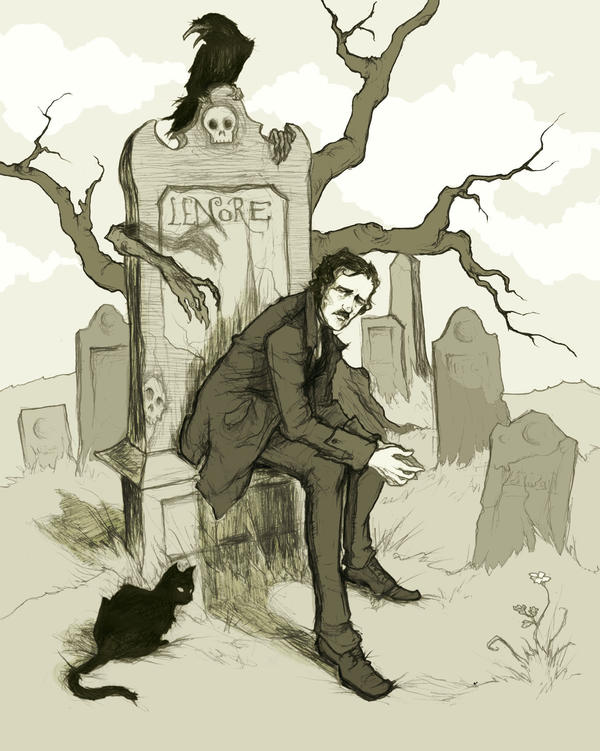
Your favourite writer says something about you. This image is by Abigail Larson, possibly one of my favourite illustrators out there. She's designed dozens of beautiful images, including this one of Edgar Allen Poe and another of HP Lovecraft. There's no reason why your favourite writers can't influence you. Take what you love from them and mix it into your own writing. Embrace them, love them, nurture them. Don't plaigerise them but by all means quote, reference, make sneaky allusions to them. They'll probably be flattered. 
As long as you don't screw up.